


Description
PrymaLab · Research Use Only
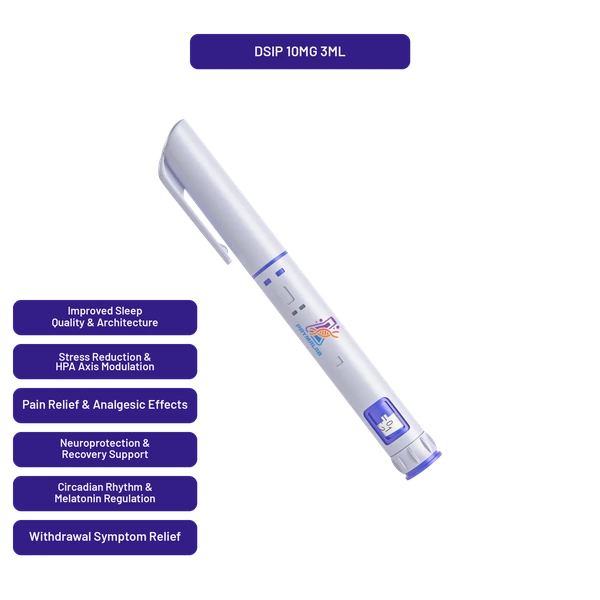
Preloaded Autoinjector | DSIP | 3ml Pen | 10mg
Nonapeptide in solution · 3ml at 10/3 mg/ml · No reconstitution step
The DSIP pen is a preloaded 3ml research autoinjector holding the nonapeptide Trp-Ala-Gly-Gly-Asp-Ala-Ser-Gly-Glu in solution at 10/3 mg/ml, giving 10mg per device. Its N-terminal tryptophan is the only aromatic residue in the molecule, and it photo-oxidises to products 4, 16 and 32 daltons heavier than the parent, which makes light protection a chemical requirement rather than a precaution.
Specification Table
| Property | Value |
|---|---|
| Device format | Preloaded autoinjector pen, glass cartridge |
| Fill volume | 3 ml |
| Concentration | 10/3 mg/ml |
| Total compound in device | 10 mg |
| Molar concentration | 10 x 0.393 mM (a 10 mg fill is 3.93 mM) |
| Compound | DSIP, INN emideltide, L-tryptophyl-L-alanyl-glycyl-glycyl-L-alpha-aspartyl-L-alanyl-L-seryl-glycyl-L-glutamic acid |
| CAS number | 62568-57-4 (free peptide). ChemIDplus also lists 69431-45-4 |
| Molecular formula | C35H48N10O15 |
| Molecular weight | 848.8 g/mol average; 848.330 Da monoisotopic |
| Amino acid sequence | Trp-Ala-Gly-Gly-Asp-Ala-Ser-Gly-Glu, linear, free N-terminal amine, free C-terminal acid |
| Solution appearance | Clear and colourless expected |
| Reconstitution required | None. Supplied as solution |
| Excipient system | Not published on the product record. Confirm against certificate of analysis |
| Solution pH | Not published on the product record |
| Storage | 2-8°C, protected from light. Do not freeze |
| Light sensitivity | High and mechanistic. The Trp1 indole absorbs in the near ultraviolet |
| Solution stability | Not established over device shelf life in published data |
| Oxidation site | Trp1. Products at +4, +16 and +32 Da are visible by mass |
| Isomerisation site | Asp5-Ala6. IsoAsp is mass-silent and forms 6.5 to 17.6-fold slower than after glycine |
| Salt form | Acetate typical, TFA salts circulate. Not published on the product record |
| Net charge at pH 7 | About -2 (calculated; not measured) |
| Purity | Per lot-specific certificate of analysis |
| Regulatory status | No approved product in any jurisdiction. INN emideltide assigned. The Pharmacy Compounding Advisory Committee voted 6 yes, 7 no, 1 abstain against 503A inclusion on 24 July 2026 |
What Changes When DSIP Ships in Solution?
Dissolving the nonapeptide starts two clocks at once: the indole ring of Trp1 begins to oxidise, and the aspartate at position 5 begins to cyclise onto the backbone of Ala6. Only the first of those is visible by mass.
Tryptophan is the residue that separates this molecule from every other compound in the bioregulator catalogue. Its indole side chain absorbs in the near ultraviolet around 280 nanometres, acts as a photosensitiser generating singlet oxygen, and is oxidised by light, by peroxide traces in excipients and by metal-catalysed radical chemistry. The named products are hydroxytryptophan at plus 16 daltons, N-formylkynurenine at plus 32, and kynurenine at plus 4. All three are heavier than the parent and all three are separable by chromatography, which is an unusual piece of good fortune: the fastest degradation route in this peptide is the one an analyst can actually see.
Position matters as well as chemistry. Trp1 sits at the free N-terminus, which is where aminopeptidases begin, and Schoenenberger (1984) measured an in-vitro breakdown half-life of about 15 minutes against brain-tissue enzymes, with endogenous material protected by binding to a carrier protein. Enzymes are not present in a sealed cartridge, but the same residue is the one every identity assay tracks, so a fill that has lost it has lost its analytical handle at the same time as its structure.
The second route is quieter. Asp5-Ala6 forms a succinimide ring by the standard aspartyl mechanism, and the ring reopens as either alpha-aspartate or beta-linked isoaspartate, which is isobaric with the parent. Alanine after aspartate is the slow case: Stephenson and Clarke (1989) found glycine in that position accelerates ring closure 6.5 to 17.6-fold relative to alanine in model hexapeptides, so this peptide isomerises far more slowly than Asp-Gly sequences do. Oliyai and Borchardt (1993) showed the pH split for the same bond type: above pH 6 isomerisation is the only product, between pH 4 and 5 hydrolysis runs alongside it, and below pH 3 hydrolysis dominates.
What is absent is worth listing. There is no methionine, cysteine, histidine or tyrosine, no C-terminal amide, no pyroglutamate site and no lipid, so thioether oxidation, disulfide scrambling and amide hydrolysis have nothing to act on. Diketopiperazine formation from the free Trp-Ala terminus is possible but slow without proline or glycine at position 2, and unmeasured for this sequence.
Self-association is the open question. Graf, Saegesser and Schoenenberger published a 1987 paper in Peptides on degradation and aggregation of this nonapeptide in plasma and serum, and its figures could not be retrieved for this page, so aggregation in a buffered cartridge is unmeasured rather than excluded. The molecule is very hydrophilic, with a calculated XLogP3 of -7.1, and no amyloid-type assembly has been reported for it.
There is no approved product whose formulation could be borrowed. The 1980s human studies used freshly prepared synthetic material given intravenously, and the composition and dosage form of the Russian preparation Deltaran could not be verified. No buffered-solution shelf-life study exists, so every claim about dsip solution stability rests on the model-peptide kinetics above rather than on data for this peptide.
Why the DSIP Pen Needs Real Light Protection
Light protection on this device has a named mechanism rather than a general one: the Trp1 indole absorbs in the near ultraviolet, and absorbed energy drives photo-oxidation to chemically different molecules that no assay of the parent will detect for the analyst.
Most short acidic bioregulators have no chromophore above about 220 nanometres, so protecting them from light is good laboratory practice with no measurable consequence attached. This peptide is the exception in the range. Fluorescent and LED bench lighting both emit in the region the indole absorbs, and the peptide can sensitise singlet oxygen that then attacks its own ring. A cartridge left out on a bench for an afternoon is not merely warming up.
The practical instruction follows from that. Return the device to its opaque packaging between sessions, work under reduced lighting where the procedure allows, and record cumulative light exposure alongside the fill date. Amber cartridge housing is justified on this product in a way it is not on the tetrapeptides sold beside it.
The same chromophore pays the researcher back. Absorbance near 280 nanometres gives a direct concentration check that peptides without aromatic residues cannot offer, and the oxidation products fluoresce and absorb differently: a spectrum losing intensity near 280 while gaining absorbance between 320 and 400 nanometres points to kynurenine-type products rather than to dilution error.
How Concentrated Is the DSIP Pen?
At 10mg in 3 ml the concentration is 10/3 mg/ml, the molar concentration is 10 x 0.393 mM, and each 0.01 ml increment carries 10/300 mg of peptide, which for a 10 mg fill is 33.3 micrograms.
Working the 10 mg example through: 3.333 mg/ml divided by 848.8 g/mol and multiplied by 1000 gives 3.93 mM, or 3,927 micromolar. One 0.01 ml increment holds 33.3 ug, which is 39.3 nanomoles; ten increments deliver 333 ug. The general forms are 10/300 mg per 0.01 ml and 10/30 mg per 0.1 ml.
The published human figure gives that arithmetic a reference point. Every human study of this peptide used the same intravenous quantity, 25 nmol/kg, which is 21.2 ug/kg and about 1.5 mg for a 70 kg participant. At 3.333 mg/ml, 0.45 ml of solution holds that 1.5 mg, so a single 10 mg device contains roughly six and a half times the total quantity given to one person in the 1981 insomnia series. For in-vitro work the numbers run the other way: reaching a 10 nanomolar working concentration from 3.93 mM requires a 393,000-fold serial dilution, and 1 micromolar needs 3,930-fold.
No primary-source water solubility figure for this peptide was found, so nothing published constrains the fill. Charge and a topological polar surface area of 407 square angstroms point to ready solubility, but that is inference. The peptide calculator handles the dilution conversions.
DSIP Pen vs Vial: What Does the Format Suit?
The dsip pen vs vial question turns on the tryptophan rather than on convenience: a sealed cartridge in the dark protects that residue well, and each session exposes the remaining solution to headspace and to whatever bench light the procedure allows.
The DSIP 10mg lyophilized vial keeps the indole chemically quiet until diluent goes in, so a solution made up on the morning of an experiment has an oxidation history known to the hour. The pen trades that for a concentration fixed at manufacture and for the removal of diluent-volume, dissolution and transfer error, which is the general trade the pen versus vial article works through.
For this molecule the tilt is application-specific. Repeated equivalent draws across a few weeks, where a constant background of oxidised material is acceptable, favour the device. Work that depends on a known oxidation state at the moment of use, or that will run for months, favours a vial opened fresh. The preloaded autoinjector category page covers graduation resolution, cold-chain history and the fields to check before ordering; a nasal spray is also listed, which makes the choice three-way for this compound.
What the DSIP Pen Product Record Does Not State
Five things are missing from the record and each one changes how a result should be read: the salt form, the formulation pH, the excipient system, the fill date, and confirmation that the fill is the unmodified nonapeptide rather than its phosphorylated analogue.
The last of those is specific to this compound. The Ser7-phosphorylated form, DSIP-P, is a distinct molecule reported to be substantially more potent, and it is not a salt. A certificate should show a monoisotopic mass of 848.330 daltons, not 928.296. That single number separates the two.
The salt form changes how much peptide a weighed milligram holds, since acetate and trifluoroacetate contribute different counterion mass to an 848.8 dalton peptide. The pH decides whether the Asp5 bond isomerises or hydrolyses. The excipient system matters more here than for a peptide with no oxidation site, because peroxide impurities in polysorbates and polyethylene glycols, and trace transition metals, are exactly what oxidises an indole ring; whether a chelator or an antioxidant is present is a question the record does not answer. Confirm all five against certificate of analysis.
DSIP Pen Storage and Verifying the Device
Correct dsip pen storage is 2 to 8°C, in the dark and never frozen, and on this compound the light half of that instruction carries more weight than the temperature half.
Inspect the solution against a white background before each draw: clear, colourless and free of particulate. Bring the cartridge to ambient temperature before actuating, because cold raises viscosity and viscosity moves delivered volume in a spring mechanism and viscosity shifts delivered volume in a spring-driven mechanism, and verify delivered volume gravimetrically once per device. Those steps are generic; the checks below are not.
Absorbance near 280 nanometres is the concentration handle, and it is the reason this device can be checked in ways the tetrapeptide pens cannot. Run a spectrum against a matched blank, then compare with a same-day reference made from a lyophilized vial rather than with a literature figure obtained in unknown buffer. Mass spectrometry resolves the oxidation series cleanly, with peaks at plus 4, plus 16 and plus 32 daltons above 848.8, and it misses the isoaspartate formed at Asp5 entirely, since that isomer carries the parent mass. A shallow reversed-phase gradient is what separates the isomer. General storage principles for research peptides are set out in the peptide storage and stability article.
What Does the DSIP Literature Actually Report?
The published record is one 1977 rabbit electroencephalography paper, four small open-label human series from the 1980s and 1990s totalling under 100 evaluable participants, and a review calling the molecule a still unresolved riddle. No receptor and no encoding gene have been found.
Schoenenberger and Monnier (1977) infused the synthetic nonapeptide intraventricularly in 58 rabbits and reported increased delta and spindle electroencephalographic activity, with analogues and metabolites inactive. That paper defined the molecule. Effects since reported in animals are species-dependent, appearing as slow-wave activity in rabbits and rapid-eye-movement changes in cats, follow a bell-shaped response curve, and are abolished by most single-residue substitutions (Schoenenberger 1984).
The human series are small and uncontrolled. Schneider-Helmert and Schoenenberger (1981) gave 6 middle-aged chronic insomniacs 25 nmol/kg intravenously in an open design and reported longer sleep with fewer interruptions, arousal in the first hour followed by sleep promotion from the second, an effect lasting about 6 hours, and no daytime sedation. Dick, Grandjean and Tissot (1983) gave the same quantity intravenously to 67 patients in alcohol or opioid withdrawal; 27 percent were lost to follow-up and 48 of 49 evaluable patients were reported to have benefited, with no control group. Backmund and colleagues (1998) published an open trial in opioid detoxification as a letter. Kovalzon and Strekalova (2006) describe the literature as contradictory.
Mechanism remains a hypothesis. Kovalzon and Strekalova (2006) note that no gene encoding this sequence has been identified in any mammalian genome, and Gimble and colleagues (2009) proposed a chance sequence homology with the glucocorticoid-induced leucine zipper protein rather than a receptor. Proposed mediators at NMDA, alpha-1 adrenergic and opioid sites are untested hypotheses. Pharmacokinetics amount to an in-vitro half-life near 15 minutes and blood-brain-barrier passage in dogs and rats (Banks 1982; Kastin 1981); no published human study used the subcutaneous route at all. The site’s research overview article covers the historical work in more detail.
Unstudied: an adequately sized placebo-controlled trial, the subcutaneous route in humans, human pharmacokinetics, modern GLP toxicology, immunogenicity, and stability in buffered solution.
What Is the Safety and Regulatory Position?
No regulator anywhere has approved this peptide, and in July 2026 a US advisory committee voted against recommending it for pharmacy compounding, which makes it the rare research compound whose regulatory file records an explicit rejection rather than silence.
An International Nonproprietary Name, emideltide, has been assigned, along with UNII YN28Z5YZ73 and ChEMBL2104403, and none of that is a marketing authorisation. No record exists in Drugs@FDA, in the EMA register, or with PMDA, TGA and Health Canada. FDA placed emideltide in Category 2 of the interim 503A bulk drug substances list on 29 September 2023 and removed it effective 22 April 2026 pending advisory review. At the Pharmacy Compounding Advisory Committee meeting of 24 July 2026, under docket FDA-2025-N-6895 with opioid withdrawal, chronic insomnia and narcolepsy as nominated uses, the vote was 6 yes, 7 no and 1 abstention against inclusion. It was the only one of seven peptides considered that week that the committee declined to recommend. The peptide was not found by name on the WADA Prohibited List, which should be confirmed against the current document, and the Russian status of Deltaran is unverified.
Adverse findings in the published series are sparse rather than reassuring. Schneider-Helmert and Schoenenberger (1981) reported nothing beyond transient arousal in the first hour; Dick and colleagues (1983) specified none. FDA reviewers in 2026 judged the studies short, small and insufficient to establish safety or effectiveness, and flagged immunogenicity as uncharacterised. Confusion between this peptide and the more potent phosphorylated analogue would matter for any quantitative comparison. No modern toxicology exists in any species.
What Does the DSIP Literature Report About Sleep?
Delta sleep-inducing peptide was named for an effect that later work struggled to reproduce. Monnier and Schoenenberger isolated it in 1977 from the cerebral venous blood of rabbits in induced slow-wave sleep, and the naming assumed the peptide caused the delta activity it was associated with. Subsequent studies of sleep architecture in humans and animals gave mixed results. Some reported increased slow-wave sleep and shorter sleep onset; others found nothing distinguishable from placebo on any measure of sleep efficiency.
The human work is small and old. A handful of trials in the 1980s gave the nonapeptide to insomniac subjects and to healthy volunteers, with polysomnography measuring deep sleep, REM sleep and total sleep time. Reported changes were modest, inconsistent between groups, and not replicated at scale. No study established a dose-response relationship, and no modern trial has revisited the question with current polysomnography. Claims about sleep quality, sleep patterns or the sleep-wake cycle from this compound rest on that literature and should be described as unsettled rather than established.
Sleep regulation itself is worth stating accurately. The process is driven by circadian rhythm signalling from the suprachiasmatic nucleus, by adenosine accumulation across the waking day, and by neurotransmitter systems including GABA, orexin and histamine, with melatonin acting as the timing signal from the pineal gland. A neuropeptide would have to act somewhere in that architecture to affect it, and no receptor for this neuropeptide has been found. Where DSIP acts, if anywhere, has never been established: no receptor has been identified for it, which is a substantial gap for a compound named after a physiological effect.
What Else Has Been Attributed to This Peptide?
A long list, most of it from small studies. Reported effects on the stress response include lowered cortisol in some animal work, and stress resilience is the framing that follows from it. Effects on the hypothalamus and on pituitary output have been reported, including changes in growth hormone and luteinizing hormone secretion, which is where the hormonal balance language originates. Activity against oxidative stress appears in a small number of rodent papers.
The analgesic claim has the most substantial supporting work outside sleep. Studies in the 1980s and 1990s reported reduced pain perception in animal models and, in a small clinical series, improvement in patients with chronic pain. The mechanism was not established, and the work was not followed up. Immune function has been examined in a similar way, in a handful of papers, without a clear result.
Recovery is the word that carries most of this compound’s current marketing, and it is worth unpacking. Recovery from exercise, recovery of sleep debt and recovery from stress are three different physiological processes with three different literatures, and DSIP has been formally studied in none of them. The recovery framing borrows from the sleep claims, which borrow from a 1977 correlation. Nothing in the record measures recovery by any defined endpoint.
Is the DSIP Peptide Peptide Therapy, and What Is Its Regulatory Position?
No, and the distinction is worth holding firmly. Peptide therapy is a service description used by clinics offering peptide preparations to patients, and it is not a regulatory category. This device holds a research preparation, and no peptide therapy protocol circulating for the DSIP peptide derives from a published trial of it. Peptide therapy schedules for this compound were written by the people selling it.
The regulatory facts are short. No FDA-approved product contains this nonapeptide, and no other regulator has approved it either. It has never had an approved indication anywhere, so there is no label, no monitoring schedule and no adverse event table. Sleep disorders, meanwhile, are diagnosed conditions with FDA-approved treatments behind them: the approved options for insomnia include benzodiazepine receptor agonists, dual orexin receptor antagonists, a melatonin receptor agonist and low-dose doxepin, all with registrational trials. Peptide therapy marketing that presents a research compound as an alternative to those is comparing categories rather than products, and peptide therapy is not a regulated practice with agreed standards.
Side effects have never been catalogued for this molecule, which is a statement about the size of the record rather than about the compound. The published studies were small, short and not designed to detect adverse events, so their silence carries no information. There is no toxicology package in any species, no pharmacokinetic data, and no long-term exposure record. A vial reconstituted with bacteriostatic water at the bench would carry the same blank record as this device does. Side effects of this compound are unknown rather than absent, and that is the accurate way to describe them.
Published Literature
Every reference here was opened at source, and none of it addresses the delivery format.
- Schoenenberger GA, Monnier M. Proc Natl Acad Sci U S A. 1977;74(3):1282-1286. DOI: 10.1073/pnas.74.3.1282 PMID: 265572
- Schoenenberger GA. Eur Neurol. 1984;23(5):321-345. DOI: 10.1159/000115711 PMID: 6548966
- Schneider-Helmert D, Schoenenberger GA. Experientia. 1981;37(9):913-917. DOI: 10.1007/BF01971753
- Dick P, Grandjean ME, Tissot R. Neuropsychobiology. 1983;10(4):205-208. DOI: 10.1159/000118012 PMID: 6328354
- Backmund M, Meyer K, Rothenhaeusler HB. J Clin Psychopharmacol. 1998;18(3):257-258. DOI: 10.1097/00004714-199806000-00016 PMID: 9617990
- Kovalzon VM, Strekalova TV. J Neurochem. 2006;97(2):303-309. DOI: 10.1111/j.1471-4159.2006.03693.x
- Gimble JM, Ptitsyn AA, Goh BC, et al. Obes Rev. 2009;10 Suppl 2:46-51. DOI: 10.1111/j.1467-789X.2009.00661.x PMID: 19849801
- Graf MV, Saegesser B, Schoenenberger GA. Peptides. 1987;8(4):599-603. DOI: 10.1016/0196-9781(87)90031-3
Frequently Asked Questions
What is the DSIP pen?
A preloaded 3ml autoinjector holding the nonapeptide Trp-Ala-Gly-Gly-Asp-Ala-Ser-Gly-Glu in solution at 10/3 mg/ml, 10mg in total, with no reconstitution step. It is supplied for laboratory research only. No approved product containing this peptide exists in any jurisdiction, and a US advisory committee voted against recommending it for compounding in July 2026.
Does DSIP come in a pen?
Yes. This listing is a preloaded 3ml autoinjector supplied as a ready-made solution, alongside a lyophilized vial and a nasal spray on the same site. The question does dsip come in a pen usually means whether the solution form is stable enough to be worth it, and the answer depends on how well the tryptophan is protected from light.
Why does light protection have a real mechanism for this peptide?
Because Trp1 is the only aromatic residue and its indole ring absorbs in the near ultraviolet around 280 nanometres. Absorbed energy drives photo-oxidation and sensitises singlet oxygen, which then attacks the ring. Most short acidic peptides have no chromophore above 220 nanometres, so their light protection is precautionary rather than chemical.
Which oxidation products form, and can mass spectrometry see them?
Hydroxytryptophan at plus 16 daltons, N-formylkynurenine at plus 32, and kynurenine at plus 4, all above the parent mass of 848.8. Every one of them is heavier than the intact peptide and separable by chromatography, so the fastest degradation route in this molecule is one an analyst can actually measure.
Has dsip solution stability been measured?
Not in a buffered formulation. Graf and colleagues (1987) studied degradation and aggregation in plasma and serum, and Schoenenberger (1984) reported an in-vitro enzymatic half-life near 15 minutes, but no shelf-life study in solution exists. Statements about dsip degradation in solution therefore come from model peptides and from the tryptophan oxidation literature.
DSIP pen vs vial: which suits which work?
The pen suits repeated equivalent draws from one lot over a few weeks with a constant background of oxidised material accepted. A lyophilized vial reconstituted on the day suits work needing a known oxidation state at the moment of use, or a study running for months. Nanomolar assays gain nothing from either format.
What is the correct DSIP pen storage?
Two to eight degrees Celsius, in the dark, never frozen. On this compound the darkness matters more than the temperature, because Trp1 photo-oxidation is the fastest route available to the molecule. Return the device to opaque packaging between sessions and record cumulative light exposure alongside the fill date.
How much peptide does each 0.01 ml increment deliver?
10/300 mg, which for a 10 mg fill is 33.3 micrograms, or 39.3 nanomoles. Ten increments deliver 10/30 mg, which is 333 micrograms at that fill. Delivered volume in a spring-driven mechanism should be verified gravimetrically once per device rather than taken from the graduation.
What molar concentration does the device hold?
10 x 0.393 millimolar. A 10 mg fill is 3.333 mg/ml, which divided by the 848.8 g/mol molecular weight is 3.93 mM, or 3,927 micromolar. Reaching a 10 nanomolar working concentration from there needs a 393,000-fold serial dilution, and 1 micromolar needs 3,930-fold.
How does the fill compare with the quantity used in humans?
Every published human study used 25 nmol/kg intravenously, which is 21.2 micrograms per kilogram and about 1.5 mg for a 70 kg participant. At 3.333 mg/ml that quantity occupies 0.45 ml, so a 10 mg device holds roughly six and a half times it. No published human study used the subcutaneous route.
Which salt form is in the pen?
The product record does not say. Vendor listings usually give acetate, and trifluoroacetate salts also circulate. The counterion contributes mass to a weighed milligram of an 848.8 dalton peptide, so whether 10mg is net peptide or gross salt changes the delivered quantity. That is a certificate of analysis question.
How is the fill distinguished from the phosphorylated analogue?
By monoisotopic mass. The unmodified nonapeptide is 848.330 daltons; the Ser7-phosphorylated form is 928.296. The phosphorylated molecule is a distinct compound reported to be substantially more potent, and it is not a salt of the parent, so a certificate showing the wrong mass describes a different experiment entirely.
Why does the isomerisation at Asp5 matter less than it does for other peptides?
Because alanine follows the aspartate rather than glycine. Stephenson and Clarke (1989) found glycine in that position accelerates succinimide formation 6.5 to 17.6-fold relative to alanine, so this sequence isomerises comparatively slowly. The isoaspartate produced is still isobaric with the parent and invisible to a mass check.
What human evidence exists?
Four small open-label series. Six chronic insomniacs given 25 nmol/kg intravenously (Schneider-Helmert 1981), 67 patients in withdrawal with 27 percent lost to follow-up (Dick 1983), an open detoxification trial published as a letter (Backmund 1998), and further open series in the 1980s. None was placebo-controlled and none used subcutaneous injection.
Has a receptor ever been identified?
No. Kovalzon and Strekalova (2006) note that no receptor has been found and no gene encoding this sequence has been identified in any mammalian genome, which is why they call the molecule a still unresolved riddle. Gimble and colleagues (2009) proposed a chance homology with a leucine-zipper protein instead.
What did the FDA advisory committee decide in 2026?
On 24 July 2026 the Pharmacy Compounding Advisory Committee voted 6 yes, 7 no and 1 abstention against adding emideltide to the 503A bulks list, under docket FDA-2025-N-6895. It was the only one of seven peptides considered that week that the committee declined to recommend. FDA had listed it in Category 2 on 29 September 2023.
Is this peptide approved anywhere?
No. An International Nonproprietary Name, emideltide, and a UNII have been assigned, and neither is a marketing authorisation. Nothing appears in Drugs@FDA, the EMA register, PMDA, TGA or Health Canada, and the status of the Russian preparation Deltaran could not be verified. This research preparation is not a medicine.
Does DSIP actually induce sleep?
The evidence is unsettled. Delta sleep-inducing peptide was named after a 1977 correlation, not a demonstrated mechanism, and later studies of sleep architecture gave mixed results: some reported increased slow-wave sleep and shorter onset, others found nothing separable from placebo on sleep efficiency. The human work is small, from the 1980s, and has not been revisited with modern polysomnography.
Has a receptor been identified for it?
No, and that is a substantial gap for a compound named after a physiological effect. Sleep regulation runs through circadian signalling, adenosine accumulation and neurotransmitter systems including GABA, orexin and histamine, with melatonin as the timing signal. Where this nonapeptide acts within that, if anywhere, has never been established.
What else has been attributed to the DSIP peptide?
Lowered cortisol in some animal work, giving the stress response and stress resilience framing; changes in growth hormone and luteinizing hormone secretion via the hypothalamus; antioxidant activity against oxidative stress in a few rodent papers; and an analgesic effect on pain perception, including a small clinical series in chronic pain that was never followed up. Immune function has been examined without a clear result.
What does the recovery claim rest on?
The sleep claims, which rest on a 1977 correlation. Recovery from exercise, recovery of sleep debt and recovery from stress are three different processes with three different literatures, and this peptide has been formally studied in none of them. No published work measures recovery by any defined endpoint.
What is the regulatory position and side effect record?
No FDA-approved product contains this nonapeptide and no regulator has approved it anywhere, so there is no label and no adverse event table. Sleep disorders have FDA-approved treatments with registrational trials behind them. Side effects here have never been catalogued because the studies were small, short and not designed to detect them, so they are unknown rather than absent.
Compliance Statement
The DSIP autoinjector is sold exclusively for laboratory research use. It is not a drug, food, or cosmetic product, and it is not a dietary product of any kind. It is not approved by the FDA or any comparable authority for human or veterinary use. This product is not intended to diagnose, treat, cure, or prevent any disease. It must not be given to humans or animals. Purchase is restricted to qualified researchers and institutions operating within applicable laws. All handling is the responsibility of the purchasing laboratory.
Other formats of DSIP
DSIP is also stocked as DSIP 5MG and DSIP 10mg Nasal Spray. Each listing states its own quantity and concentration, and the pen and vial comparison explains what changes between formats.








Reviews
There are no reviews yet.